

Mechnical Tools
When designing a tool for resistance welding, it is best to start at the weld nugget
area first then work back to the power supply.
Determine what needs to happen through the work piece first then decide how this will be accomplished.
It is too late if you get the tools first then determine how you are going to use them. Determine the
amount of current and time needed to do the weld and the force required across the electrode. Next determine
the current carrying circuit required. Do you simply need to weld nuggets along a flange or do you need to
produce a welds in the middle of wall of a train?
There are very important mechanical concerns in resistance welding. Proper electrode alignment, proper
electrode force with follow-up, good part and electrode geometry, with sufficient cooling capabilities
are some of the considerations that have to be accounted. The welding gun will transfer the power to the
weld zone thus its capabilities are of great importance for producing quality welding results.
The work piece electrical resistance that is presented across the electrodes is measured in micro-ohms.
Since the welding current required may be in the range of a few thousand amperes up to 250,000 amperes, the
range of voltage across the work piece would only be around 0.5 to 1.5 volts. When all considered, the
resistance of the tools that carry the welding current will exceed the work piece resistance. The integral
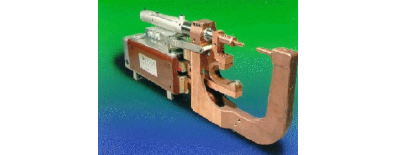
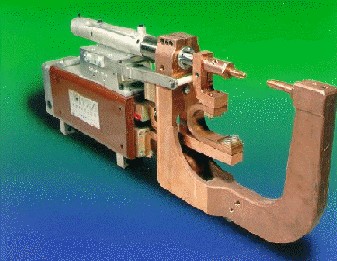
transformer-gun design above is very efficiently designed yet its resistance is still higher than that of the
work piece. The welding transformer that is couple to the gun apparatus may need to be in the order of 4 to 12 volts
in order to overcome the tool resistance. There are situations where an integral transformer-gun design can not be used.
In such cases, the transformer is remote from the weld gun by means of large current carrying conductors. This increases
the tool resistance and as a result, the output voltage across such transformers may need to be as high as 30 volts just
to get the 0.5 to 1.5 volts across the work piece.
To Top